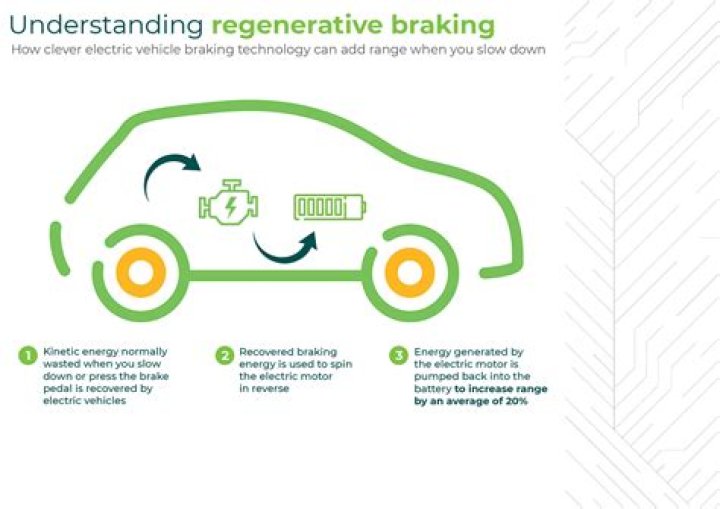
Hybrid cars can be made with flywheels instead of batteries. In these "flybrids", the kinetic energy recovered during braking spins a flywheel. The recovered kinetic energy is stored in the spinning wheel, to be released upon acceleration.
What is hybrid flywheel?
In simple terms, an automotive flywheel hybrid system leverages power from a mechanical flywheel motor to augment power from an internal combustion engine for short periods.
Do electric cars have flywheels?
The flywheel is inserted in between the main energy storage (assumed to be a battery) and the traction motor in an electric vehicle.
Why electric motors do not have flywheel?
A flywheel does not have "virtually infinite energy density" - in fact the energy density is quite low, especially when you realize you have to move it with you. So, electric cars don't use flywheels as their principal energy supply because they have generally a low energy density.
How does a hybrid car drive the wheels?
A series hybrid uses the electric motor to drive the wheels, and the petrol engine powers a generator that produces the electricity and charges the battery. The petrol engine never propels the car forward – it simply provides the energy for the electric motor.
20 related questions foundWhat is the disadvantage of a hybrid car?
Poor handling: Hybrids have more machinery than conventional cars, which adds extra weight and reduces fuel efficiency. So, hybrid car manufacturers have had to make smaller engines and batteries to cut down on weight. But this results in reduced power for the vehicle and support in the body and suspension.
Do hybrid cars need to be plugged in?
Hybrid electric vehicles are powered by an internal combustion engine and an electric motor, which uses energy stored in batteries. A hybrid electric vehicle cannot be plugged in to charge the battery. Instead, the battery is charged through regenerative braking and by the internal combustion engine.
Do f1 engines have flywheels?
Some Formula One race cars now use devices called KERS (Kinetic Energy Recovery System) which store the energy generated in braking in flywheels rotating at very high speed, instead of letting it go to waste as heat, as is the case with normal vehicles.
Do Teslas have flywheels?
Tesla's Core Electric Vehicle Catalog
The Tesla flywheel is evident within its EV business model, which is based on 3 levels of consumer service: selling, servicing, and charging its electric vehicles, which maintains control over sales and service.
Do hybrid cars use KERS?
These flywheel cars, dubbed kinetic energy recovery system (KERS) vehicles, are another form of hybrid vehicle because they have an electric drive system supplementing the combustion engine. The flywheel car is simple to describe if not to engineer.
What cars have KERS?
Formula One
With the introduction of KERS in the 2009 season, only four teams used it at some point in the season: Ferrari, Renault, BMW and McLaren. Eventually, during the season, Renault and BMW stopped using the system.
Does a car have a flywheel?
Every car has a flywheel. Flywheels are heavy metal disks, between 12 and 15 inches in diameter, with gear teeth cut into its circumference. They are attached to the rear of the crankshaft, between the engine and the transmission.
Are flywheels efficient?
The energy efficiency (ratio of energy out per energy in) of flywheels, also known as round-trip efficiency, can be as high as 90%. Typical capacities range from 3 kWh to 133 kWh. Rapid charging of a system occurs in less than 15 minutes.
Where are flywheels used?
The main stationary applications of flywheels are in uninterruptible power supplies (UPS), and trackside support in traction (rail) and mining systems. Emerging applications are power quality (PQ) systems, peak shaving in electrical power systems, and power smoothing in renewable energy systems.
How does KERS flywheel Work?
Very simply the system comprises a flywheel connected by a continuously variable transmission [CVT] to the drivetrain. If you move the CVT toward a gear ratio that would speed the flywheel up it stores energy. Conversely, if you move toward a ratio that would slow it down then it releases energy.
What's a flywheel in a car?
A flywheel is a heavy disc attached to the end of a rotating shaft that helps smooth out the engine's power pulses and store energy through rotational momentum.
Why are flywheels used?
Flywheels are often used to provide continuous power output in systems where the energy source is not continuous. For example, a flywheel is used to smooth fast angular velocity fluctuations of the crankshaft in a reciprocating engine.
How do f1 cars harvest energy?
Since 2014, Formula 1 engines have been designed to harvest lost energy and reuse it in the car. The energy is generated in two kinds of motors: MGU-K (Motor Generator Unit - Kinetic) and MGU-H (Motor Generated Unit - Heat). The energy generated from these motors is then stored in the ES (Energy Store).
What happens if you don't plug-in your hybrid car?
Convenience. A plug-in hybrid runs on gas or electricity. Yes, you do need to charge its battery as mentioned – typically at home, if not also during the day, or en route – but if you do not, the gas engine will move the car just fine in normal hybrid mode.
What happens if you don't plug-in a plug-in hybrid?
However, a plug-in hybrid never has to be plugged in and will continue operating in "hybrid" mode (using a combination of the gas engine and the electric motor or motors) indefinitely, as long as you keep filling up the gas tank.
Does a plug-in hybrid recharge while driving?
Do plug-in hybrids charge while driving? The engine in a PHEV will charge the batteries slightly to give you a boost when you need it, but due to the larger battery pack, it won't charge all the way up. You need to plug your PHEV in to get the full zero-emission benefits that come with it.
Why hybrid cars are not popular?
Battery Issues
The biggest drawback to a hybrid car is the battery systems. Nearly all hybrid cars use batteries that are integrated into the powertrain. That's good news when you're on the road, since it means the car operates under battery power some of the time. The result is better gas mileage.
What can go wrong with hybrid cars?
What are The Most Common Issues a Hybrid Car Experiences?
- Weak Batteries. Hybrid car batteries are generally weaker than standard car batteries, which means they need replacement sooner. ...
- Oxygen Sensors. ...
- Catalytic Converter. ...
- Evaporative Emissions System. ...
- Low Highway Gas Mileage.
What is the biggest problem with hybrid cars?
Poorer fuel efficiency and handling
Hybrids and PHEVs are packing two drivetrains into the one car, which means more weight, which can negatively affect fuel efficiency and handling, as well as the aforementioned need to compromise by downsizing both the battery and ICE.